
2 min
Your code's "hidden" vendors: the Keyv/NPM case and third-party risk
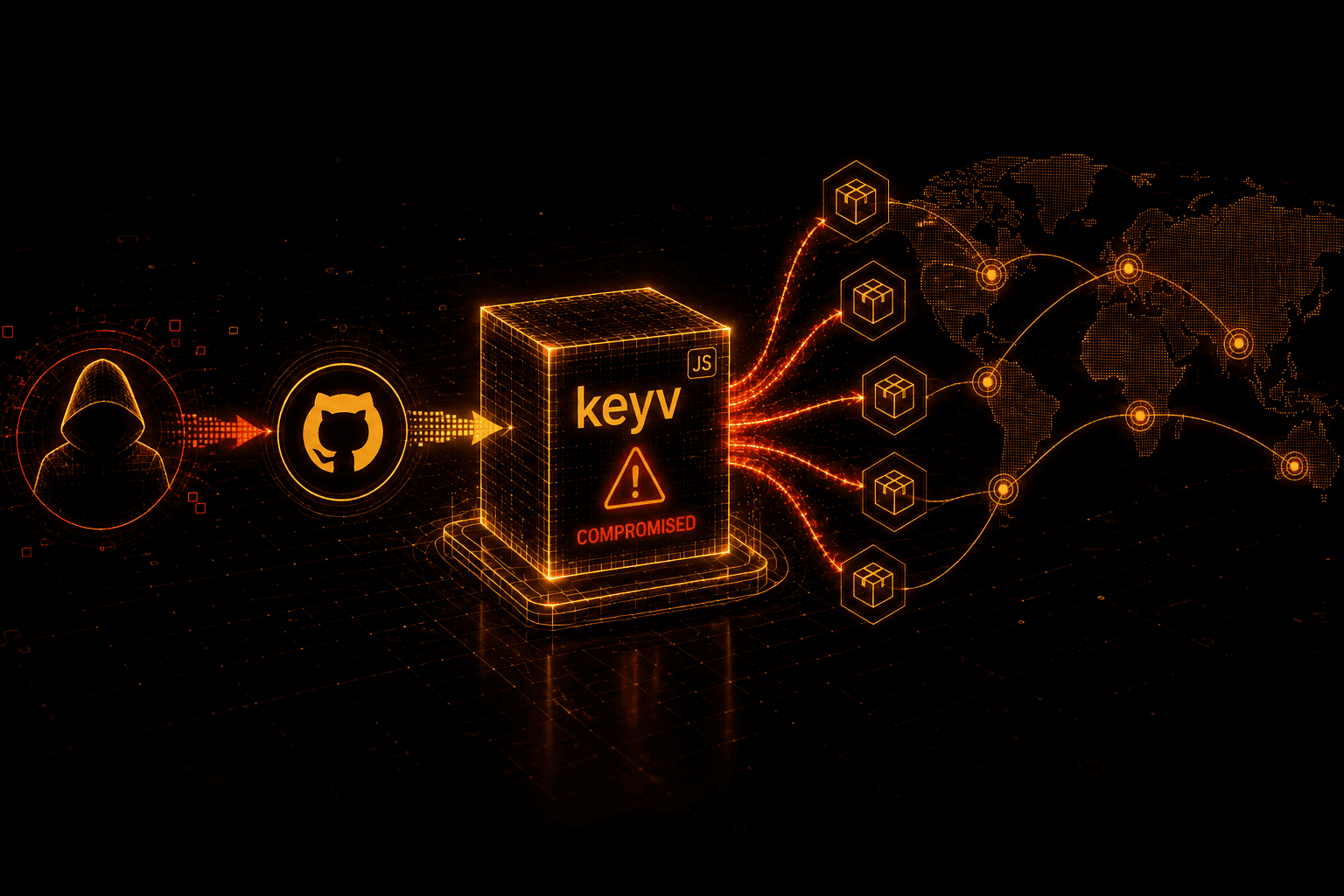
On August 4, 2026, attackers compromised the GitHub account of the developer who maintains keyv, a widely used open-source JavaScript library, and used it to push malicious code into keyv and a family of related caching packages. keyv alone is downloaded around 127 million times a week, so the blast radius was immediate.
The attackers did not exploit a flaw in npm. They abused a trusted maintainer account and the project's normal release workflow, so the poisoned versions were published with valid signatures and looked completely legitimate. Anyone who installed or updated an affected package ran the malicious code automatically, during installation, before the library was ever used.
The payload is a self-replicating worm that researchers link to the Shai-Hulud family. It harvests credentials from the machine it lands on (npm and GitHub tokens, AWS keys, SSH keys, CI/CD secrets), encrypts them, and uploads them to attacker-controlled GitHub repositories whose description reads "Shai-Hulud: Here We Go Again". It then spreads to other packages the victim is able to publish. Within hours it had reached hundreds of packages across multiple organizations, with a combined total of more than 2 billion installs per month, and it was still expanding.
Why This Is a Third-Party Problem
Nobody clicked a phishing link. No firewall was bypassed. A developer installed a routine update and inherited someone else's compromise, buried inside a dependency the organization had trusted for years and, in most cases, never chose directly.
That is the part worth sitting with. You can run a mature internal security program and still be exposed because a component three layers down in your build was poisoned upstream. The open-source code your products are built on behaves like any other vendor. It sits inside your perimeter, and its security is not something you control.
Signatures and provenance did not stop this. They confirm where a package came from, not whether the code inside it is safe. When the source account itself is compromised, a perfectly signed release still ships malware.
What Actually Helps
By the time an incident like this is officially disclosed, the damage is usually done. The affected maintainer did not know their own account was compromised until the worm was already spreading. Defense has to be continuous rather than reactive: knowing which open-source components live in your applications, watching for exposure tied to them, and being able to match a public incident against your own environment quickly.
That is the gap QuimeraX's CTI capabilities are built to close, surfacing exposure that starts outside your perimeter and correlating it against your risk chain with enough lead time to act.
Because whether the weak link is a vendor, a partner, or a single open-source package, the result is the same. Your supply chain's risk has always been your risk too.
To support organizations assessing their exposure, the QuimeraX Threat Intelligence team published a comprehensive CTI report covering the Shai-Hulud campaign in depth. The report includes a detailed technical analysis of the attack, affected packages, indicators of compromise (IOCs), attacker infrastructure, impact assessment, and practical mitigation guidance.
Want to see how much of your exposure starts outside your own perimeter? Talk to the QuimeraX team.
References
QuimeraX. keyv 6.0.0 Compromised With an Install Hook and an IDE Auto-Run Hook - Real-time Open Source Software Supply Chain Security. Published on August 4, 2026. Available at: news.quimerax.com/news/97fb3f1c-0c0b-4327-87b7-08f637ab5d7e