
9 min
Third Party Breaches: Why Your Vendor Is A Risk To You Too

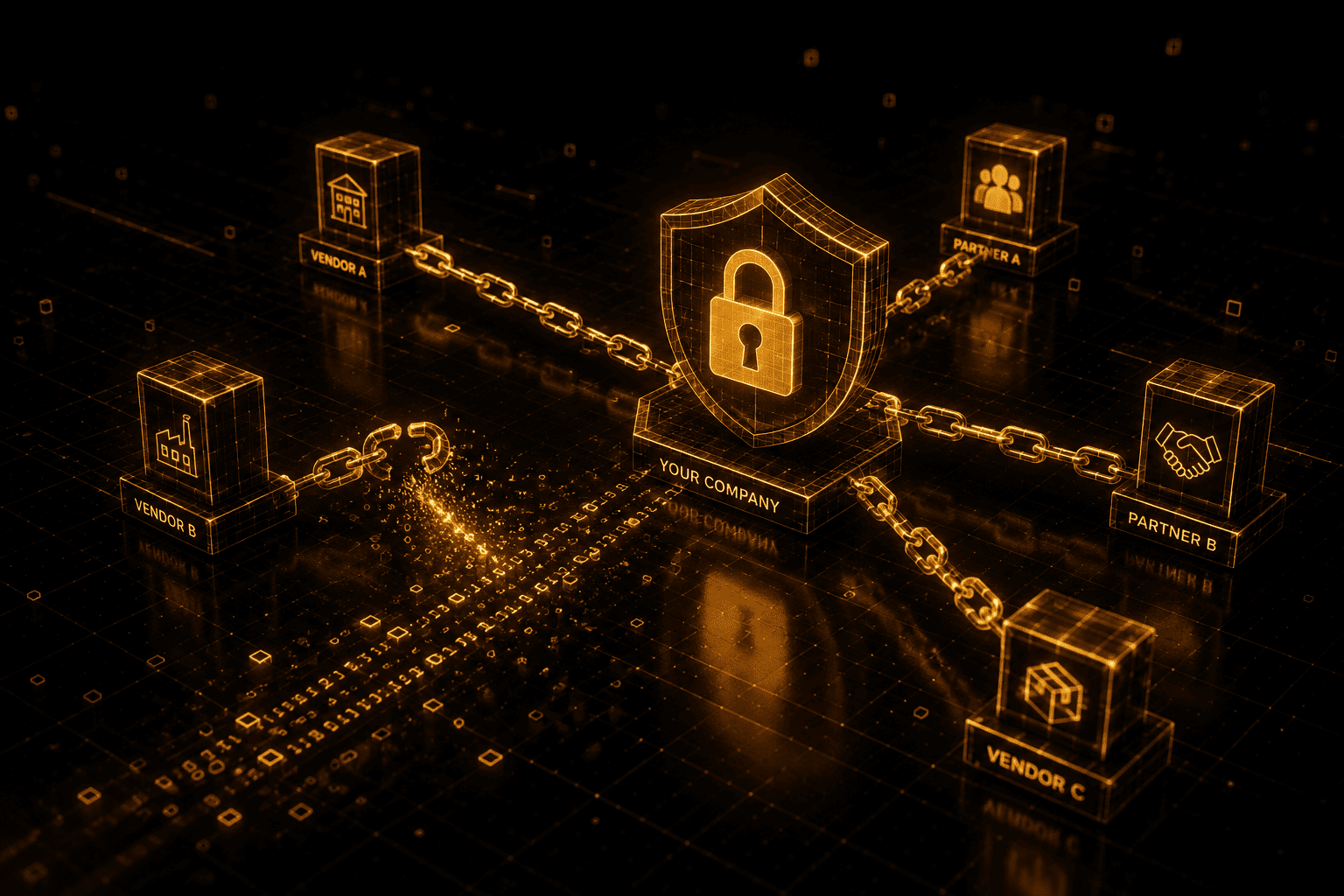
Your company can have the most mature security program on the market, with rigorous patch management, continuous monitoring, and a well trained security team, and still be compromised by a breach that did not happen inside your own systems. It happened at the payment processor you hire. At the outsourced accounting firm. At the HR platform that stores your employees' data. At the logistics partner that has access to your CRM to track deliveries. Or at that infrastructure monitoring tool or IT support company (MSP) that holds privileged access and administrative credentials to manage your corporate servers.
This is the core problem of third party risk: your company's security perimeter does not end at your own systems. It ends where the last vendor with access to any of your data or systems ends, and most companies do not have clear visibility into exactly where that line sits.
What Is A Third Party Breach
A third party breach, in security terms, refers to any data exposure incident that happens not within your organization, but within a vendor, partner, service provider, or any other company that has access, even limited, to your data or systems.
The main difference from an internal incident is that you do not control, and in most cases cannot even directly audit, that third party's security posture. You trust that they follow good practices, but you rarely have continuous visibility into whether that is true, and when it is not, your company bears the impact of a security decision that was never yours to make.
This type of exposure happens in distinct ways:
Direct leak of data you shared. You sent a customer database to a telemarketing company, or employee data to a benefits platform, and that company suffers a security incident that exposes the data you shared.
Compromise of credentials with access to your environment. A vendor has an API integration with your systems, or an employee of that vendor has access to one of your tools, and their credentials are compromised, giving an attacker a legitimate entry point into your environment.
Compromised shared or white label infrastructure. You use a vendor's white label platform to offer a service to your customers, and a vulnerability in that platform compromises not only the vendor, but every client that depends on it, including you.
Indirect leak via your vendor's subcontractors. The vendor you directly hired also outsources parts of the service, and the incident happens two or three layers below the contractual relationship you have direct visibility into.
Why This Risk Is Structurally Underestimated
Most companies treat third party security as a one time process, carried out at the moment of hiring and rarely revisited afterward. This model has structural flaws that explain why third party risk is consistently underestimated.
Security due diligence happens once, but the risk is continuous
When a company hires a new vendor, some kind of security assessment process usually exists: a questionnaire, a required certification, a contractual clause. That process captures the vendor's security posture at that specific moment. But any company's security posture changes over time: employees leave and join, infrastructure gets updated or neglected, new systems get integrated. A vendor that was secure at the time of hiring may have critical vulnerabilities two years later, and the contractual relationship rarely provides for continuous reassessment of that posture.
The third party chain runs deeper than it looks
When you think of "vendors," you probably think of direct contracts: the payroll company, the CRM platform, the logistics partner. But each of these vendors also has its own suppliers, cloud systems, infrastructure partners, subcontractors, that you have never assessed and probably do not even know exist. The real risk of your digital supply chain is almost always deeper and broader than the map of direct vendors you can actually list.
Shared data quickly loses traceability
Once you share a dataset with a vendor, whether for processing, integration, or any other purpose, you lose direct control over how that data is stored, replicated, or shared further downstream. Backup copies, the vendor's test environments, additional integrations it makes with other systems, all of this expands the risk surface of your data without you having visibility or control over that expansion.
The incentive to report is asymmetric
When a vendor suffers a security incident, it has a commercial incentive to minimize communication about it, especially if the breach involves data belonging to corporate clients like you. In many cases, companies discover they were affected by a third party breach not through proactive notification from the vendor, but through external threat intelligence monitoring, when the data is already circulating publicly.
Real Scenarios Of How The Risk Materializes
To understand the practical impact of this problem, it is worth looking at the most common patterns of how third party breaches affect companies that, on the surface, did everything right internally.
The payment processor with an unpatched vulnerability
An e-commerce company integrates its checkout with a third party payment processor. The company itself follows every security best practice internally, but the processor, responsible for a critical part of the flow, keeps a legacy system with a vulnerability known for months, without applying the fix. When that vulnerability is exploited, the card data of the store's customers is exposed, even though the store itself never had any security failure in its own systems. For the end customer, and for regulators, the breach is treated as the responsibility of the company that processed the sale, regardless of where the failure technically occurred.
The accounting firm with reused credentials
Mid sized companies frequently outsource financial and accounting functions to specialized firms, which have access to internal ERP or financial systems to perform reconciliations and closings. An employee at that firm reuses the same password across multiple services, and that password is compromised in a completely unrelated breach, posted on a credential trading forum. Because that credential also grants access to the client's financial environment, a breach at a third party service, with no direct connection to the company, becomes the entry point for unauthorized access to its financial system.
Beyond that, the current threat landscape shows that attackers are not just after static passwords, but also active session cookie theft through Infostealer malware. The technical danger here is that even if the vendor has MFA (Multi Factor Authentication) enabled, stealing these tokens bypasses that protection, letting the criminal log straight into the system while simulating the third party's computer. Identifying this type of breach through threat intelligence (CTI) gives the security team the visibility needed to invalidate the compromised session and mitigate the risk before the access is actually exploited. Many outsourced service providers (accountants, developers, designers) use personal computers for work. If that provider's child downloads a pirated game infected with an Infostealer, the malware steals every piece of data saved in the browser within seconds, including the active session of your company's ERP. The criminal buys that "access token" on underground forums and walks straight into your financial environment, without your internal MFA triggering any new authentication alert.
The HR platform with an employee data leak
Benefits management, recruiting, and payroll platforms concentrate a huge volume of sensitive personal employee data: national tax IDs, bank details, health information for benefit plans, home addresses. When one of these platforms suffers a breach, even if the contractual relationship is just "use of an HR tool," the reputational and legal impact falls directly on the client company, because it is its own employees' data that is exposed, regardless of who technically stored that data.
The logistics partner with a misconfigured API
Retail and e-commerce companies frequently integrate systems with logistics partners for order tracking, sharing customer data such as name, address, and phone number through APIs. When that partner keeps a misconfigured API, without proper authentication or with excessive permissions, an attacker can exploit that entry point to access data from multiple clients of that logistics partner, including your company, even though your own integration was correctly implemented on your end. A common case occurs when the logistics partner uses an API vulnerable to authorization flaws (such as IDOR). An attacker simply changes a number in the order ID sent in the external API's URL and, instead of seeing customer A's tracking, is able to pull the delivery history, names, and addresses of thousands of your company's customers, without needing to crack a single password.
Why Handling This With A Contract Alone Is Not Enough
The most common corporate response to third party risk is contractual: liability clauses, required security certifications, incident notification SLAs. These measures matter, but they have a fundamental limitation: they define what happens after something has already gone wrong, they do not prevent the breach from happening, and contractual notification often arrives after the reputational and operational damage is already underway.
Contractual clauses also do not replace real visibility. A contract can require a vendor to "maintain adequate information security practices," but that does not tell you whether, in practice, that vendor's domains and systems are exposed, whether its employees' credentials have already surfaced in some breach, or whether the infrastructure it uses to connect with you has known, unpatched vulnerabilities.
The difference between reactive and proactive third party risk management lies exactly there: continuously monitoring external signals of exposure related to your vendors, instead of relying exclusively on security questionnaires filled out once a year and on notifications that depend on the goodwill of the affected vendor itself.
Best Practices For Managing Third Party Risk
Some practices consistently help reduce the exposure that comes from your chain of vendors and partners.
Map the entire chain, not just direct vendors. Understand what systems, data, and integrations each vendor has access to, and, as far as possible, who the subcontractors operating behind them are. You cannot manage what you cannot map.
Classify vendors by level of access and criticality, not just contract value. A small vendor with access to sensitive data represents more risk than a large vendor with access only to public information. Monitoring priority should follow the level of exposure, not the size of the contract.
Treat security due diligence as a continuous process, not an onboarding step. A vendor's security posture at the time of hiring is no guarantee of its security posture two years later. Periodic reassessments, and ideally continuous monitoring, should be part of the relationship, not an isolated step at the start.
Monitor external exposure related to your vendors, not just your own. Leaked credentials from a vendor's employees, compromised domains related to it, or mentions of it in threat forums are risk signals that affect you indirectly, and that are only visible through active monitoring, not through reports the vendor itself decides to share.
Set clear, short incident notification deadlines contractually, but do not rely on them exclusively. Notification clauses matter, but the time between an incident happening and being formally communicated tends to be longer than ideal. Independent monitoring reduces that dependency.
Have a specific response plan for incidents that originate outside your organization. Your incident response team probably has well defined processes for internal events. Check whether those processes also cover scenarios where the breach originates at a third party, with communication and responsibility chains that are often more complex.
How QuimeraX Solves This Problem
QuimeraX's TPCRM (Third Party Cyber Risk Management) module was designed exactly for the scenario described in this article: consolidating risk visibility that originates outside your direct perimeter, but that directly affects your organization. Instead of relying on static questionnaires filled out once, TPCRM continuously aggregates exposure signals related to third party breaches, normalizing that information into a governance view that lets you track how this risk evolves over time.
This work is supported by the Cyber Threat Intelligence (CTI) module, which monitors external sources, such as leak repositories, underground forums, and compromised databases, identifying when credentials or data associated with your vendors and partners appear exposed, even before any formal notification reaches you. Each relevant exposure is automatically correlated with your risk chain, enabling real impact assessment and response prioritization based on criticality, not assumption.
The practical result is moving away from a posture where you only learn about a vendor breach once it has already caused impact, to instead discovering this type of exposure with enough lead time to act.
Want to understand the level of exposure your vendor chain represents today? Schedule a demo with the QuimeraX team and see how TPCRM and CTI map, in practice, the risk that comes from outside your direct perimeter.
Conclusion
The security perimeter of a modern company is no longer defined by the physical or technological boundaries of the organization itself. It is defined by the sum of every vendor, partner, and provider that has some level of access to your data or systems, and each of these links represents a real, and often invisible, extension of your risk.
Treating third party security as a contractual formality, settled at the time of hiring and forgotten afterward, ignores the dynamic nature of this risk. A vendor's security posture changes over time, the chain of subcontractors runs deeper, and shared data loses traceability. The only sustainable way to manage this risk is to treat it with the same seriousness and the same continuous monitoring cadence applied to your own internal infrastructure.
Because, in the end, when a breach happens at a vendor, the end customer, the regulator, and the affected reputation do not distinguish between "it was our problem" and "it was a third party's problem." Your vendor's risk has always been your risk too.